
Table of Contents
By Robert Ryan for Pokemon Joy
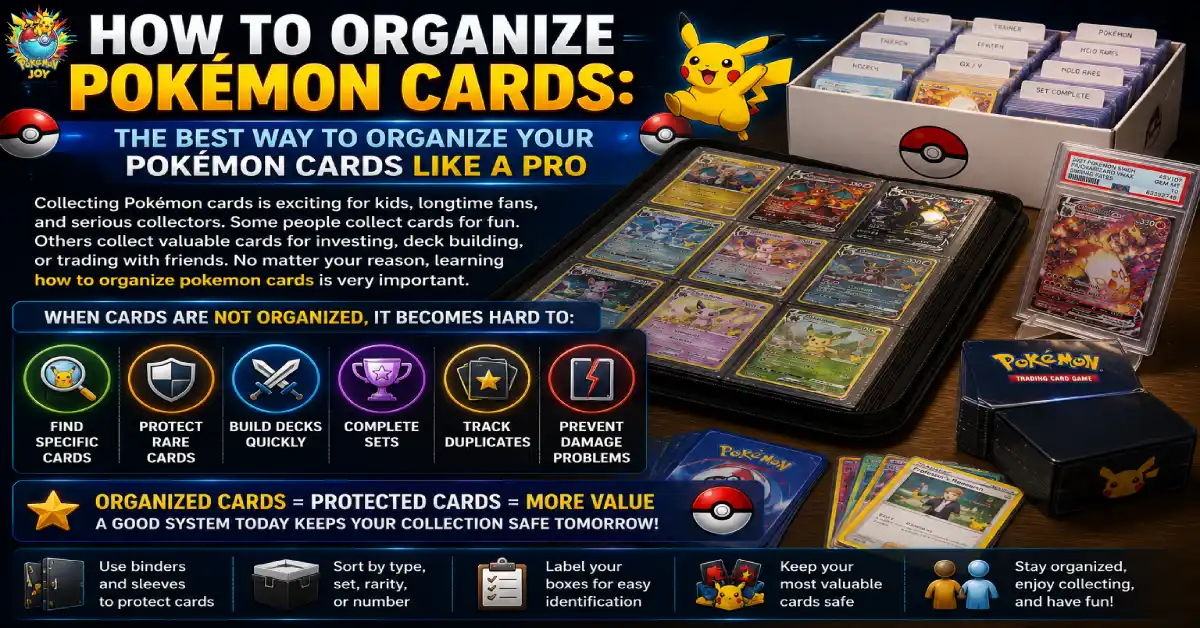
Collecting Pokémon cards is exciting for kids, longtime fans, and serious collectors. Some people collect cards for fun. Others collect valuable cards for investing, deck building, or trading with friends. No matter your reason, learning how to organize pokemon cards is very important.
When cards are not organized, it becomes hard to:
- Find specific cards
- Protect rare cards
- Build decks quickly
- Complete sets
- Track duplicates
- Prevent damage cards problems
Many collectors start with only a few Pokémon cards. Later, the collection grows into many cards stored in boxes, tins, binders, and shelves. Without a system, the collection can become messy very fast.
I learned this myself after collecting Pokémon Trading Card Game products for years. At first, I kept everything inside a shoe box. Later, I realized my holographic cards started to warp because I did not protect them correctly. After testing different organization methods, I found simple systems that help keep your collection organized safely and neatly.
In this complete guide, you will learn:
- The best way to organize Pokémon cards
- How do you sort pokemon cards properly
- Binder and card storage tips
- Best practices for storing and organizing
- How to protect valuable cards
- How to organize cards by rarity, set, Pokémon type, and Pokédex number
- How to store bulk cards safely
- The best binder size and storage options
Whether you own 50 cards or 50,000 cards, this guide will help you organize your cards in a smart and easy way.
Why It Is Important to Organize Pokemon Cards
The Pokémon Trading Card Game is one of the biggest trading cards hobbies in the world. Similar to a Baseball card collection, Pokémon card collecting becomes more enjoyable when everything is clean and organized.
Good organization helps you:
- Protect cards from damage
- Find specific card copies quickly
- Track valuable cards
- Build decks faster
- Keep complete sets together
- Make selling or trading easier
Many collectors also enjoy displaying their Pokémon cards in a clean binder because it looks professional and appeals to fans.
When cards are stored carelessly, problems can happen:
- Cards may bend or warp
- Direct sunlight may fade colors
- Indoor mold can appear in humid places
- Plastic pages can damage cards over time
- Dust may scratch holographic cards
A proper card storage setup helps prevent these problems.
Best Way to Organize Pokémon Cards
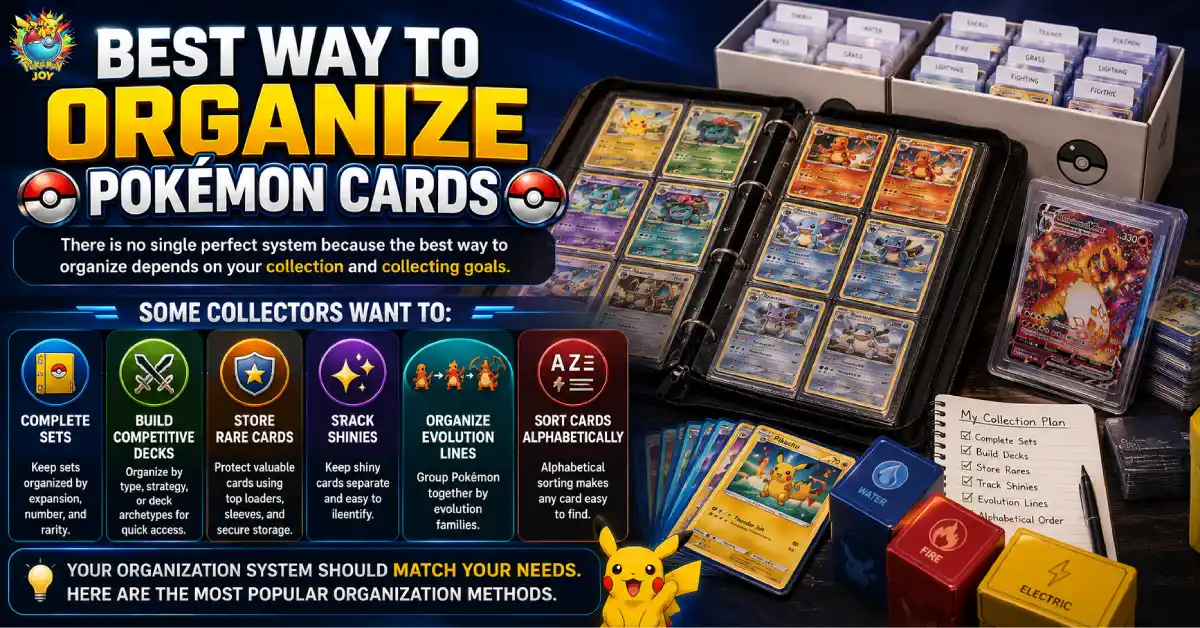
There is no single perfect system because the best way to organize depends on your collection and collecting goals.
Some collectors want to:
- Complete sets
- Build competitive decks
- Store rare cards
- Track shinies
- Organize evolution lines
- Sort cards alphabetically
Your organization system should match your needs.
Here are the most popular organization methods.
How Should I Organize My Pokémon Cards?
Many new collectors ask, “how should i organize my pokemon cards?” The answer depends on the size of your collection and your personal collecting goals.
Some collectors enjoy sorting by rarity, while others prefer organizing by set or Pokémon type. If you open booster packs often, organizing by expansion set is usually the easiest method. If you focus on deck building, sorting by elemental type and trainer cards may work better.
The best system is the one that helps you find cards quickly while keeping your collection protected and clean.
Best Way to Organize Pokémon Cards for Beginners
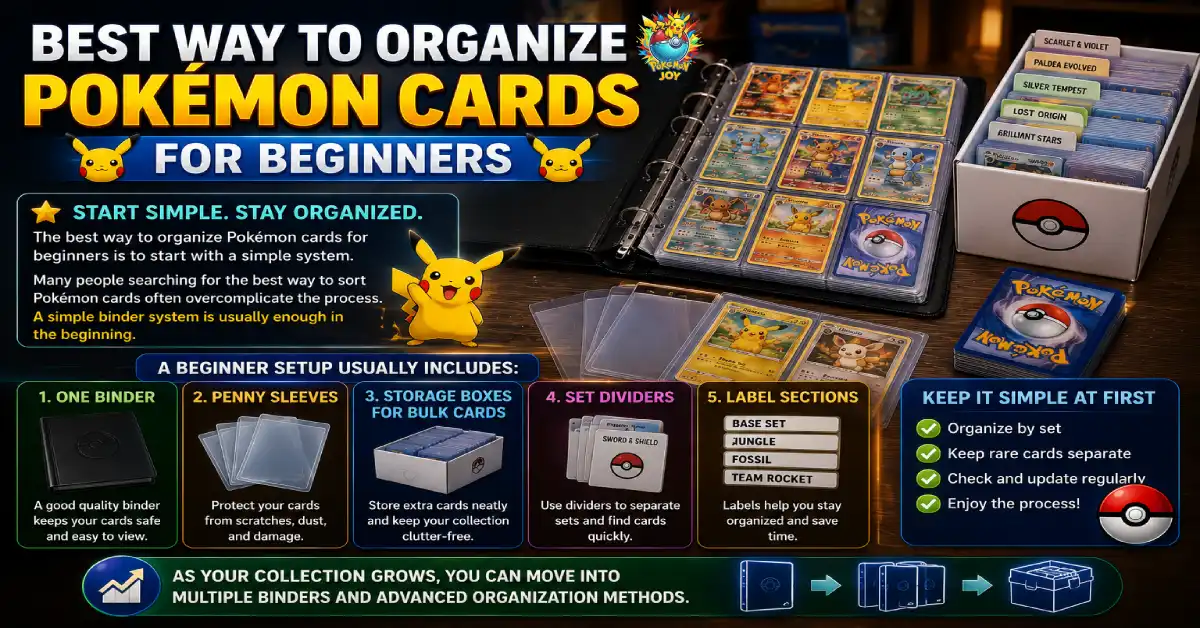
The best way to organize pokemon cards for beginners is to start with a simple system.
A beginner setup usually includes:
- One binder
- Penny sleeves
- Storage boxes for bulk cards
- Set dividers
- Label sections
Many people searching for the best way to sort pokemon cards often overcomplicate the process. A simple binder system is usually enough in the beginning.
As your collection grows, you can move into multiple binders , Card Dimension and advanced organization methods.
How to Organize Pokémon Cards in a Binder
Many collectors want to know how to organize pokemon cards in a binder because binders are one of the safest and cleanest storage options.
A binder makes it easier to:
- Protect valuable cards
- Display collections
- Find specific cards
- Track complete sets
If you are wondering how to organize pokemon card binder layouts properly, the most popular system uses:
- Standard 9-pocket pages
- Side-loading binder pages
- Penny sleeves
- Set dividers
This setup helps prevent scratches and keeps cards secure.
How Should I Organize My Pokémon Cards in a Binder?
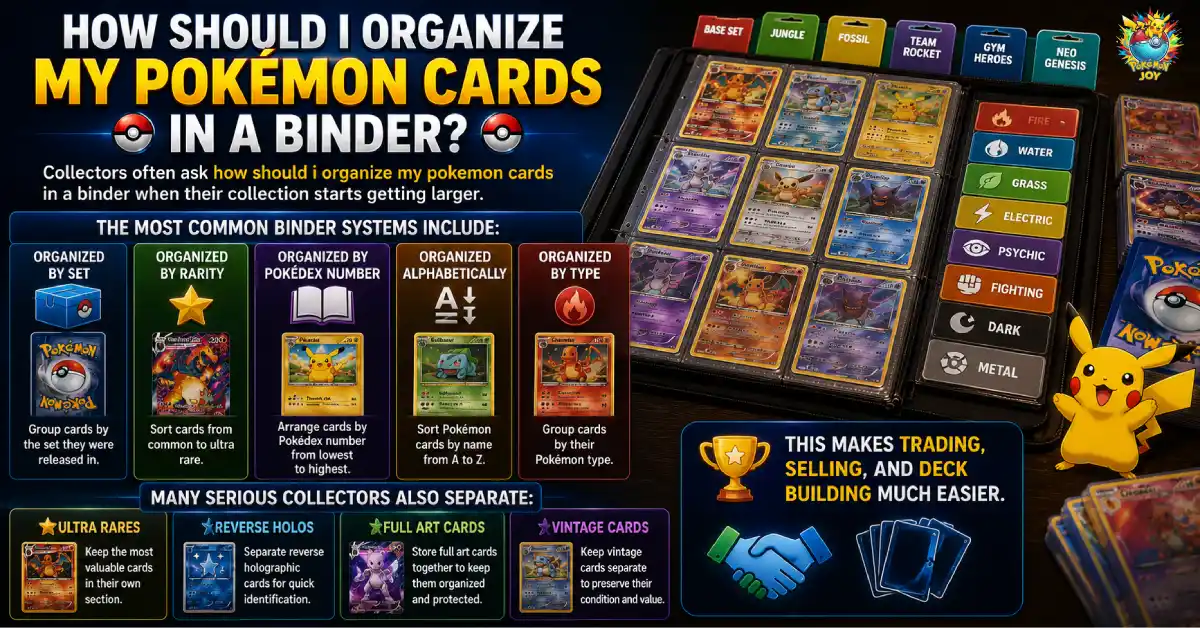
Collectors often ask how should i organize my pokemon cards in a binder when their collection starts getting larger.
The most common binder systems include:
- Organized by set
- Organized by rarity
- Organized by Pokédex number
- Organized alphabetically
- Organized by Pokémon type
Many serious collectors also separate:
- Ultra rares
- Reverse holos
- Full art cards
- Vintage cards
This makes trading, selling, and deck building much easier.
How to Arrange Pokémon Cards in a Binder
If you want to learn how to arrange pokemon cards in a binder neatly, try grouping cards in a visually clean pattern.
Popular layouts include:
- Evolution lines
- Elemental type pages
- Full set pages
- Favorite Pokémon pages
For example, Eevee and all Eeveelutions can fit beautifully across several binder pages.
Many collectors enjoy creating themed pages because it makes the collection look more professional.
How to Categorize Pokémon Cards Properly
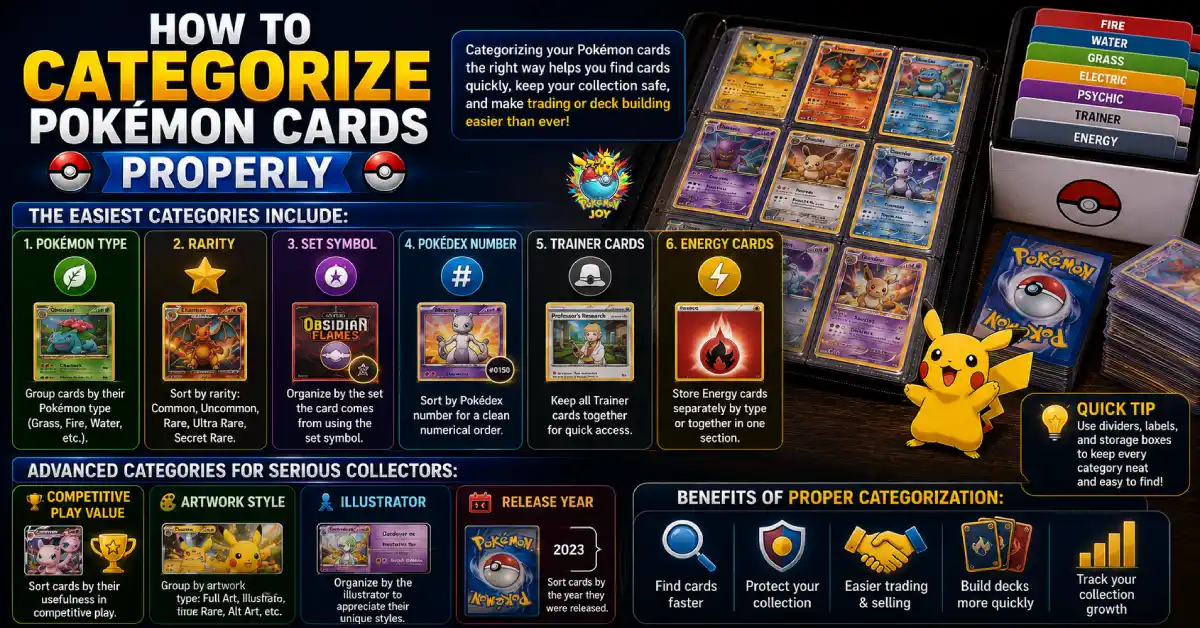
Another common question is how to categorize pokemon cards efficiently.
The easiest categories include:
- Pokémon type
- Rarity
- Set symbol
- Pokédex number
- Trainer cards
- Energy cards
Some advanced collectors also categorize by:
- Competitive play value
- Artwork style
- Illustrator
- Release year
This type of organization becomes very useful for large collections.
How to Organize Pokémon Cards by Set
Many collectors prefer learning how to organize pokemon cards by set because it follows the official Pokémon release order.
Every expansion includes a set symbol that helps identify cards quickly.
Examples include:
- Base Set
- Fusion Strike
- Crown Zenith
- Scarlet & Violet
This method works extremely well for collectors who want to complete full sets over time.
How to Organize Pokémon Cards by Number
Some collectors prefer learning how to organize pokemon cards by number using Pokédex order.
This system keeps Pokémon arranged according to official numbering from the Pokémon video game series.
Organizing cards this way:
- Looks clean inside a binder
- Makes finding cards easier
- Helps organize evolution lines naturally
Many long-term collectors enjoy this method because it feels structured and professional.
How to Organize Pokémon Cards by Type
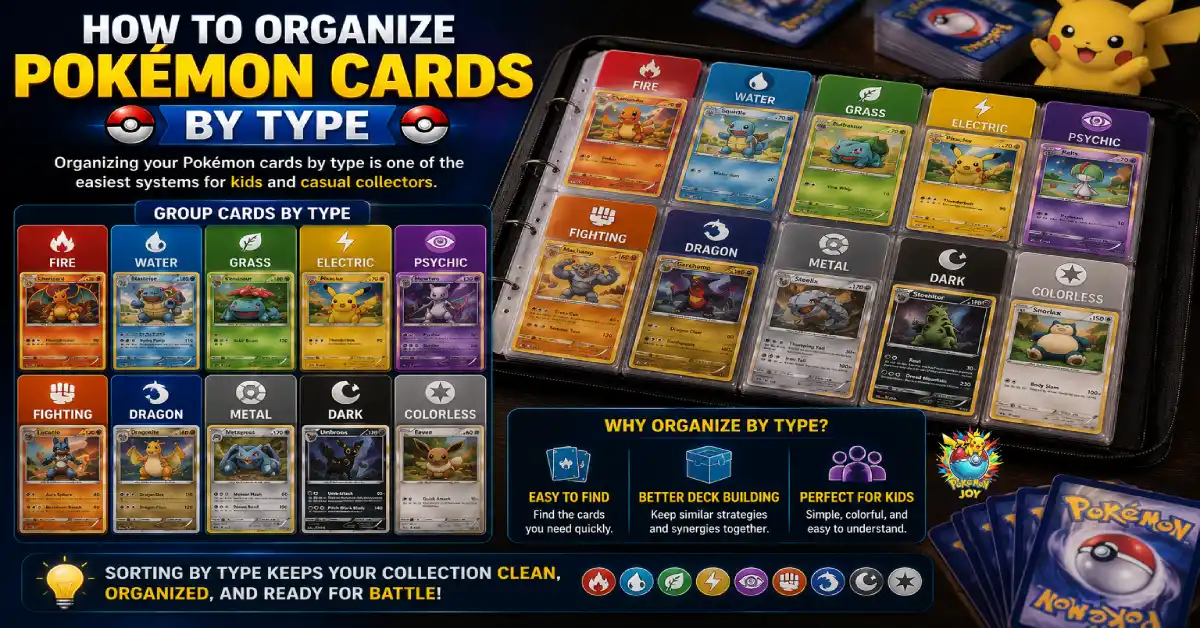
If you are wondering how to organize pokemon cards by type, this method is one of the easiest systems for kids and casual collectors.
Cards can be grouped into:
- Fire
- Water
- Grass
- Electric
- Psychic
- Fighting
- Dragon
- Metal
Sorting by type also helps with deck building because cards with similar strategies stay together.
How to Organize Pokémon Cards in Order
Collectors searching for how to organize pokemon cards in order usually combine several systems together.
A common advanced structure looks like this:
- Set order
- Pokédex number
- Rarity
- Reverse holo versions
This method keeps every card easy to track while maintaining a clean binder layout.
How to Organize Bulk Pokémon Cards
Bulk storage becomes important once collections grow larger.
If you want to learn how to organize bulk pokemon cards, start by separating:
- Commons
- Uncommons
- Duplicate cards
- Energy cards
- Trainer cards
Bulk cards are usually stored inside:
- Card boxes
- Plastic containers
- Storage drawers
Always keep bulk cards away from direct sunlight and moisture.
How to Organize Pokémon Cards as a Collector
People who collect seriously often search for how to organize pokemon cards as a collector because large collections require stronger systems.
Experienced collectors usually use:
- Multiple binders
- Spreadsheet tracking
- Set completion systems
- Graded card cases
- Protective sleeves
Collectors also inspect binders regularly to help prevent long-term chemical damage and moisture problems.
How to Organize Pokémon Card Collection Efficiently
The best way to organize a growing Pokémon card collection is to create a system early.
If you wait too long, reorganization becomes difficult because collections grow quickly.
The easiest long-term setup includes:
- Binder organization
- Set dividers
- Bulk storage boxes
- Spreadsheet tracking
- Sleeve protection
This keeps your collection organized and easier to manage over time.
How to Organize Pokémon Cards to Sell
Some collectors eventually learn how to organize pokemon cards to sell for easier inventory management.
Selling becomes much easier when cards are:
- Sorted by rarity
- Sleeved properly
- Organized by set
- Clearly labeled
Buyers also trust collections more when cards look clean and professionally organized.
How to Organize Pokémon Cards by Rarity
Many collectors prefer learning how to organize pokémon cards by rarity because it protects valuable cards better.
Rare categories often include:
- Holos
- Reverse holos
- Ultra rares
- Secret rares
- Full arts
Keeping rare cards separate reduces handling damage and makes grading preparation easier.
Organize Pokémon Cards by Set
One of the most common systems is keeping cards organized by set.
Every Pokémon card includes a set symbol near the bottom of the card. This symbol helps identify cards from different expansions.
Examples include:
- Base Set
- Scarlet & Violet
- Crown Zenith
- Evolving Skies
Many collectors prefer this system because it follows the official Pokémon release order.
Benefits of Organizing by Set
- Easy to complete sets
- Great for long-term collecting
- Helps track missing cards
- Makes reorganization simpler later
Collectors often place cards inside:
- One binder per set
- Multiple binders for larger collections
- Standard 9-pocket binder page layouts
This system works especially well for collectors who enjoy opening booster packs regularly.
Organize Pokémon Cards by Rarity
Another popular option is sorting by rarity.
This method separates:
- Commons
- Uncommons
- Rares
- Ultra rares
- Holos
- Reverse holos
- Secret rares
Many valuable cards fall into higher rarity categories.
Why Sorting by Rarity Helps
- Sorting by rarity helps collectors:
- Protect expensive cards
- Find trading cards faster
- Track cards worth grading
- Keep holographic cards safer
Rare cards should always receive extra protection.
I personally keep my ultra rares and Eevee evolution cards inside side-loading binder pages with penny sleeves for extra safety.
Organize Pokémon Cards by Pokémon Type
Sorting by type is another easy method for beginners.
This system groups cards by elemental type.
Examples include:
- Fire
- Water
- Grass
- Electric
- Psychic
- Fighting
Some collectors also organize trainers and pokemon separately.
Benefits of Sorting by Type
- Makes deck building easier
- Helps new players learn type matchups
- Simple for kids to understand
- Great for casual collections
This method also works well for people who collect specific Pokémon families or evolution lines.
Organize Pokémon Cards by Pokédex Number
Advanced collectors often organize cards using Pokédex number order.
This method follows the official Pokémon numbering system from the Pokémon video game series.
For example:
- Bulbasaur comes before Ivysaur
Eevee appears before its evolutions
Why Pokédex Organization Works Well
- Looks clean in a binder
- Makes every card easier to track
- Helps complete evolution lines
- Creates a professional collection layout
Many collectors combine Pokédex organization with set organization.
Lorem ipsum dolor sit amet, consectetur adipiscing elit. Ut elit tellus, luctus nec ullamcorper mattis, pulvinar dapibus leo.
How Do You Sort Pokémon Cards for Easy Access?
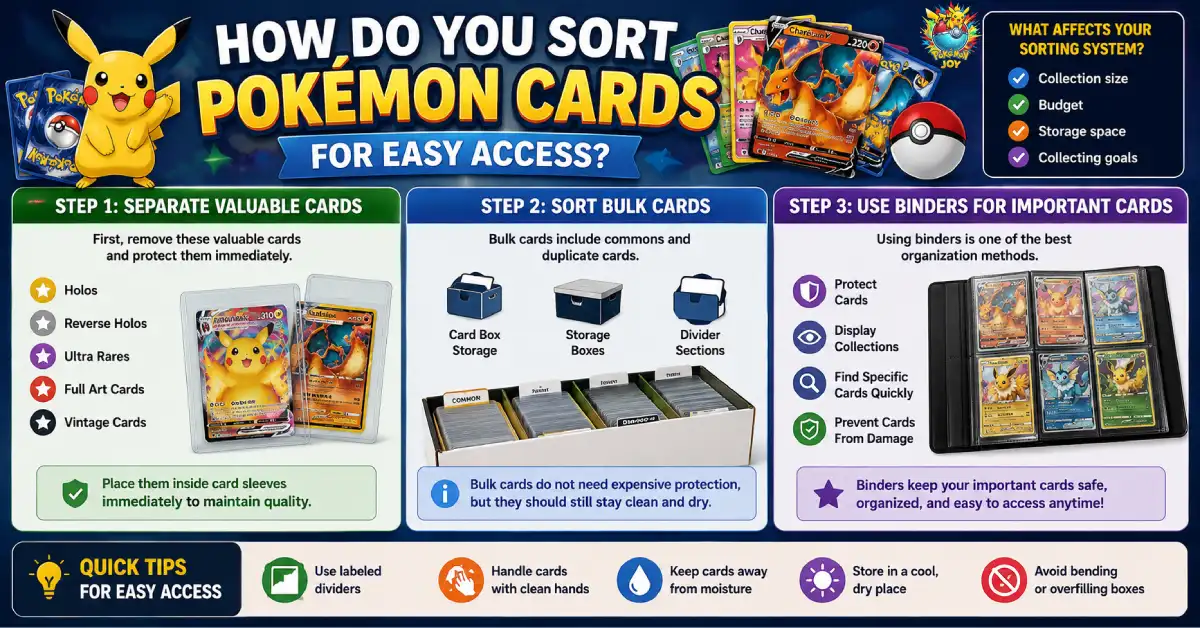
Many new collectors ask, “how do you sort pokemon cards?”
The answer depends on:
- Collection size
- Budget
- Storage space
- Collecting goals
Here is a simple beginner system and many player ask about pokemon card dimension.
Step 1: Separate Valuable Cards
First, remove:
- Holos
- Reverse holos
- Ultra rares
- Full art cards
- Vintage cards
Place them inside card sleeves immediately to maintain quality.
Step 2: Sort Bulk Cards
Bulk cards include commons and duplicate cards.
Use:
- Card box storage
- Storage boxes
- Divider sections
Bulk cards do not need expensive protection, but they should still stay clean and dry.
Bulk cards include commons and duplicate cards.
Use:
- Card box storage
- Storage boxes
- Divider sections
Bulk cards do not need expensive protection, but they should still stay clean and dry.
Step 3: Use Binders for Important Cards
Using binders is one of the best organization methods.
A binder helps:
- Protect cards
- Display collections
- Find specific cards quickly
- Prevent cards from damage
Choosing the Right Binder for Pokémon Cards
A good binder is one of the most important tools in card collecting.
Best Binder Types
Side-Loading Binder
Side-loading binder pages offer better protection because cards slide into pockets from the side instead of the top.
This helps prevent:
- Cards falling out
- Dust entering pockets
- Edge damage
Many serious collectors prefer side-loading binders.
Top-Loading Binder
Top-loading pages are cheaper and easy to find.
However, cards may slide out more easily if the binder falls.
Best Binder Size for Pokémon Cards
Binder size depends on your collection.
Small Collections
A small binder works well for:
- Favorite Pokémon
- Deck storage
Rare cards
Large Collections
Large collections may require:
- Multiple binders
- D-ring binders
- Separate set binders
Never overfill one binder because tight pages can warp cards over time.
Sleeve Cards Before Putting Them in Binder Pages
One important rule is:
Always sleeve cards before putting them in binder pages.
This creates a layer of protection against:
- Scratches
- Dust
- Moisture
Surface damage
Best Sleeve Types
Penny Sleeves
Penny sleeves are affordable and perfect for most cards.
Premium Card Sleeves
Premium card sleeves offer better protection for valuable cards.
I personally use premium sleeves for:
- Vintage holos
- Cards worth grading
- Eevee collections
- Full arts
Standard 9-Pocket Binder Page Setup
The standard 9-pocket binder page is the most common storage layout.
Each page stores 9 cards safely.
This system:
- Looks clean
- Makes every card easy to view
- Helps complete sets visually
Many collectors organize:
- 9 cards per evolution line
- 9 cards by elemental type
- 9 cards by rarity
This makes the collection more enjoyable to display.
If you enjoy Pokémon collecting and strategy content, you may also enjoy:
Best Practices for Storing Pokémon Cards
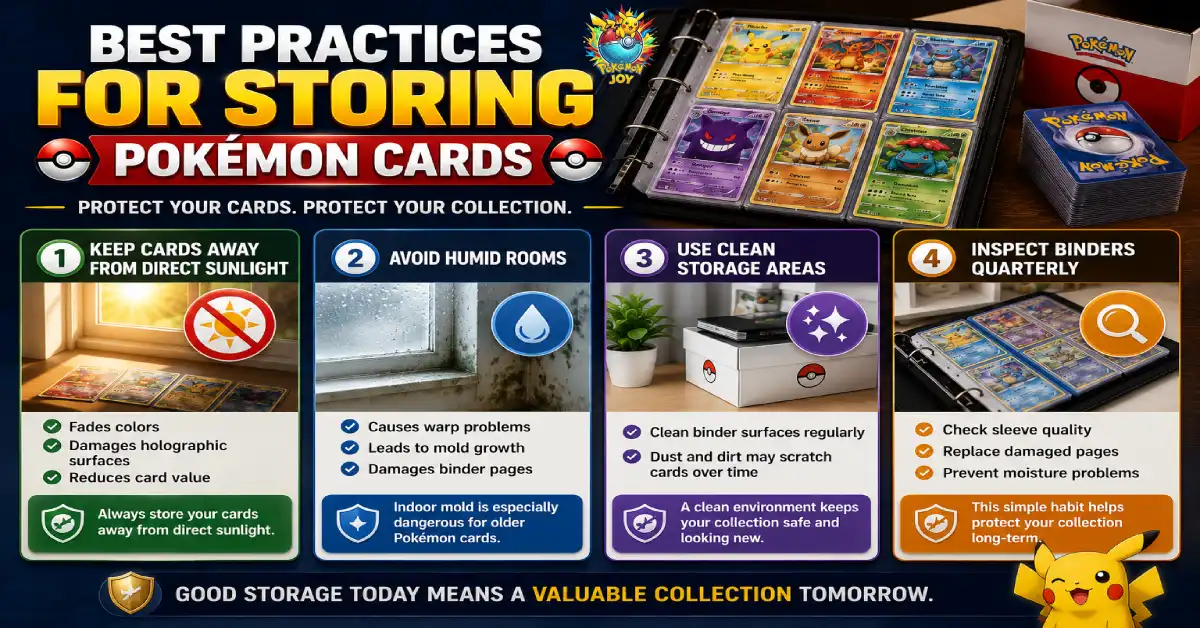
Following best practices for storing Pokémon cards helps prevent long-term chemical damage
Keep Cards Away From Direct Sunlight
Direct sunlight can:
- Fade colors
- Damage holographic surfaces
- Reduce card value
Always store your cards away from direct sunlight.
Avoid Humid Rooms
Humidity can cause:
- Warp problems
- Mold growth
- Binder page damage
Indoor mold is especially dangerous for older Pokémon cards
Use Clean Storage Areas
Clean binder surfaces regularly.
Dust and dirt may scratch cards over time.
Inspect Binders Quarterly
Serious collectors inspect binders quarterly to:
- Check sleeve quality
- Replace damaged pages
- Prevent moisture problems
This simple habit helps protect collections long-term.
Card Storage Options for Different Collection Sizes
The size of your collection changes the best storage setup.
Small Collections
Small collections work well with:
- One binder
- Small storage boxes
- Mini tins
Medium Collections
Medium collections often need:
- Multiple binders
- Card binders by set
Deck storage boxes
Large Collections
Large collections usually require:
- Shelves
- Storage boxes
- Label systems
- Spreadsheet tracking
Some advanced collectors even keep cards in a safe for maximum protection.
Should You Use a Spreadsheet for Pokémon Cards?
A spreadsheet is extremely useful for serious collectors.
You can track:
- Set completion
- Duplicate cards
- Card prices
- Trading inventory
- Deck pieces
A spreadsheet makes finding and tracking cards much easier.
Some collectors also use:
- Mobile apps
- Online databases
Barcode systems
Organize Pokémon Cards for Deck Building
Competitive players organize differently from collectors.
Deck building requires fast access to:
- Trainers and pokemon
- Energy cards
- Support cards
- Pokémon type categories
Many players sort cards:
- Alphabetically
- By elemental type
- By competitive usage
This makes tournament preparation easier.
If you enjoy battle strategy guides, you may also like reading about catching legendary Pokémon strategies.
Best Storage Boxes for Bulk Cards
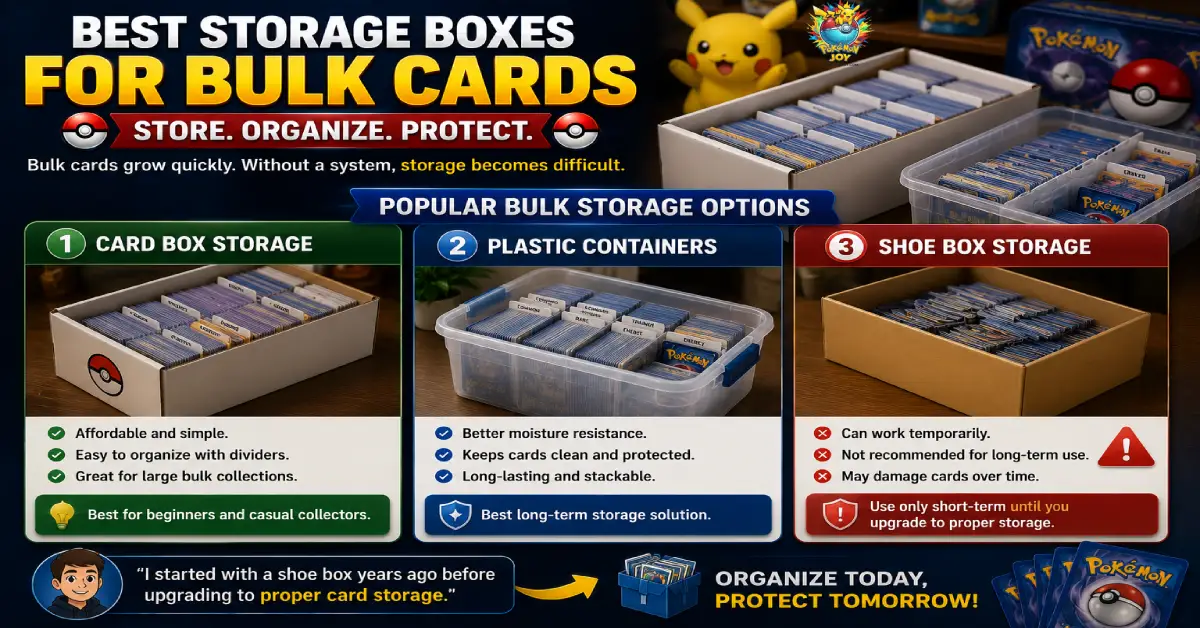
Bulk cards grow quickly.
Without a system, storage becomes difficult.
Popular Bulk Storage Options
Card Box Storage
Card boxes are affordable and simple.
Plastic Containers
Plastic containers offer better moisture resistance.
Shoe Box Storage
A shoe box can work temporarily, but long-term use is not recommended because it may damage cards.
I started with a shoe box years ago before upgrading to proper card storage.
How to Protect Valuable Pokémon Cards
Valuable cards need stronger protection.
Recommended Protection Setup
For expensive cards:
- Penny sleeve
- Top-loader
- Storage binder or case
This system helps prevent:
- Scratches
- Bent corners
- Surface wear
Collectors should also avoid touching holographic surfaces directly
Common Mistakes When Organizing Pokémon Cards
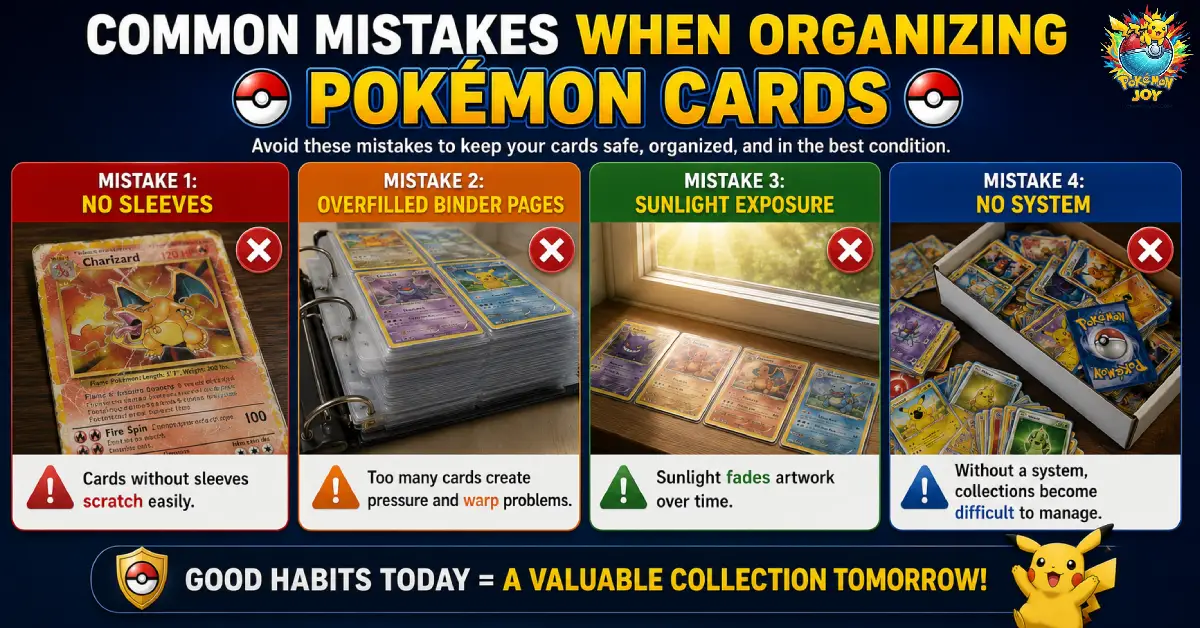
Many beginners accidentally damage cards through poor storage habits.
Mistake 1: No Sleeves
Cards without sleeves scratch easily
Mistake 2: Overfilled Binder Pages
Too many cards create pressure and warp problems.
Mistake 3: Sunlight Exposure
Sunlight fades artwork over time.
Mistake 4: No System
Without a system, collections become difficult to manage.
How Many Binders Should You Use?
This depends on your collection.
Some collectors use:
- One binder for rares
- One binder organized by set
- One binder for shinies
- One binder for favorite Pokémon
Large collections often require multiple binders.
Organizing Pokémon Cards for Kids
Children need simple systems.
The easiest systems include:
- Sorting by Pokémon type
- Sorting by color
- Sorting by favorite Pokémon
Simple systems help kids enjoy collecting while learning organization skills.
Pokémon Card Collecting and Long-Term Value
Good organization can protect card value.
Collectors often track:
- Cards worth grading
- Rare cards
- Complete sets
- Vintage holos
Proper card collecting habits help preserve condition for years.
This is similar to how Baseball card collectors protect vintage cards carefully.
Digital Tracking and Modern Card Collecting
Modern collectors often combine physical storage with digital tools.
Popular tracking methods include:
- Spreadsheet systems
- Collection apps
- Online inventory lists
This makes selling or trading much easier later.
Personal Experience Organizing Pokémon Cards
Over the years, I tested many organization methods.
At first, my collection had no structure. Cards were mixed together in tins and boxes. Finding a specific card took forever.
Later, I switched to:
- Side-loading binders
- Set organization
- Penny sleeves
- Storage boxes for bulk cards
The difference was huge.
Now I can:
- Find cards quickly
- Protect valuable cards
- Build decks faster
- Track duplicate cards easily
The system no longer feels stressful because everything has a place.
Best Pokémon Card Organization Setup for Beginners
If you are just starting, this setup works very well:
Basic Beginner Setup
- One binder
- Penny sleeves
- Standard 9-pocket binder page setup
- Storage box for bulk cards
- Simple set organization
This affordable setup offers better protection without becoming complicated.
Advanced Pokémon Card Organization Setup
Advanced collectors may prefer:
- Multiple binders
- D-ring storage systems
- Spreadsheet tracking
- Set completion tracking
- Graded card cases
This setup depends on your collecting goals and budget.
Final Thoughts on How to Organize Pokémon Cards
Learning how to organize pokemon cards makes collecting more enjoyable, safer, and less stressful.
The best organization system depends on your collection size, favorite Pokémon, and collecting goals.
Some people organize Pokémon cards:
- By set
- By rarity
- By Pokédex number
- By elemental type
- By deck usage
Others combine several systems together.
The most important thing is protecting your collection from:
- Direct sunlight
- Moisture
- Dust
- Warp damage
- Mold growth
A good binder, proper sleeves, and clean card storage habits can protect cards for many years.
Whether you collect Eevee cards, shinies, vintage Base Set cards, or modern ultra rares, staying organized helps keep your collection looking amazing.
Frequently Asked Questions:
What Pokémon card is worth $300,000?
A PSA 10 1st Edition Base Set Charizard can be worth around $300,000 or more, depending on recent sales, condition, and provenance.
What's the best way to organize bulk Pokémon cards?
Sort bulk Pokémon cards by set, Pokémon type, rarity, and card number. For large collections, use labeled boxes or storage dividers for easy access
How much are 1000 cards of Pokémon Bulk worth?
A typical lot of 1,000 bulk Pokémon cards may be worth tens of dollars, but the value varies based on card condition, rarity, set, and whether valuable cards are included.
Is there a $1,000,000 Pokémon card?
Yes. Extremely rare Pokémon cards have reached or exceeded $1 million in value, particularly rare Pikachu Illustrator cards and exceptional Charizard examples.
What is the #1 rarest Pokémon?
Pikachu Illustrator is generally considered the rarest Pokémon card, with very few copies known to exist. It is also among the most valuable Pokémon cards ever sold.
Why is 1999 Charizard so expensive?
The 1999 Charizard is expensive because of its 1st Edition status, iconic artwork, age, rarity, demand, and difficulty of finding high-grade copies.
Is a Charizard GX rare?
Yes, some Charizard GX cards are rare and valuable, but rarity and price depend on the specific set, version, condition, and grading
Are any 2026 Pokémon cards worth money?
Yes. Some 2026 Pokémon cards can be valuable, especially rare chase cards, special illustrations, promotional cards, and high-grade copies. Values depend on demand and condition.
How rare is a 1st Edition Charizard?
The 1999 1st Edition Base Set Charizard is extremely sought after, especially in high grades. PSA’s population data shows only a small number of PSA 10 copies compared with all graded examples.