
Table of Contents
By Robert Ryan for Pokemon Joy
Pokémon cards have become one of the most recognizable collectibles in the world. Millions of players, collectors, and fans purchase booster packs, elite trainer boxes, and special collections every year. Whether someone is searching for a rare Charizard, building a competitive deck, or simply collecting artwork, most fans eventually ask the same question: how are Pokémon cards made?
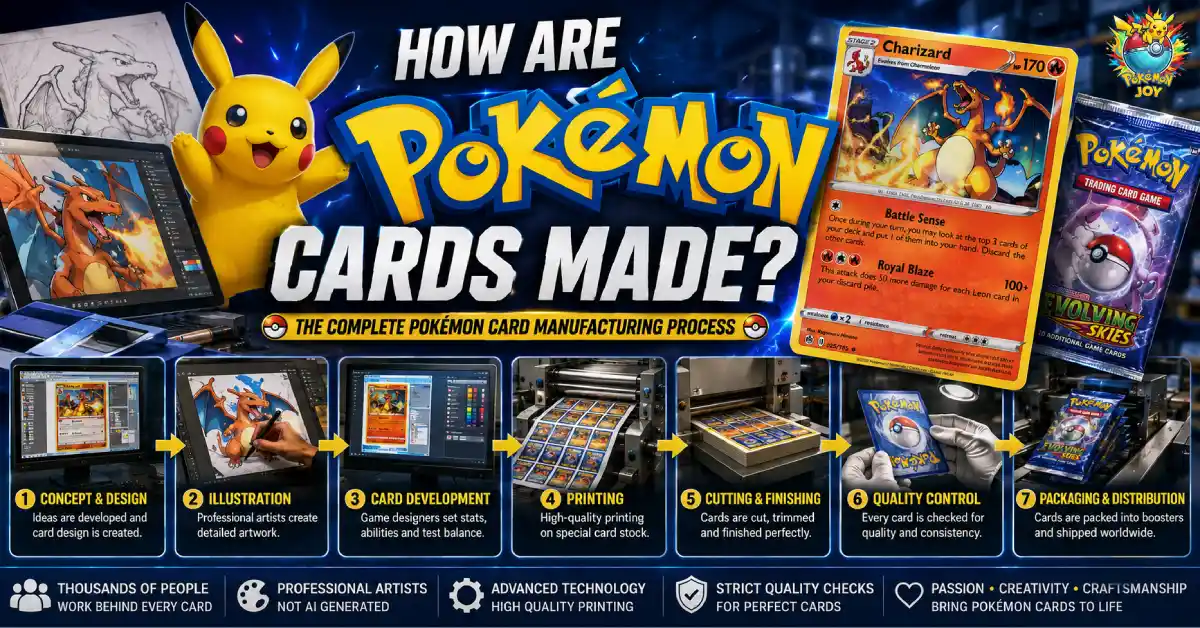
The answer is more complex than many people realize. A single Pokémon card goes through many steps before it reaches a store shelf. From concept creation and artwork development to testing, printing, cutting, packaging, and distribution, every card follows a carefully controlled manufacturing process.
One important fact that surprises many collectors is that official Pokémon cards do not use AI-generated artwork. The Pokémon Company works with hundreds of professional artists and illustrators around the world. In recent years, official illustration contests have even disqualified AI-generated submissions. While AI tools are becoming popular in custom card creation projects and hobby communities, official Pokémon card production remains firmly centered on human creativity.
Today, the Pokémon Trading Card Game (TCG) is one of the largest trading card game franchises in history. Behind every new card, booster pack, and expansion set is an enormous team of artists, designers, printers, testers, and production specialists working together to bring Pokémon to life.
As someone who has spent years researching Pokémon games, Pokémon cards, and the Pokémon collecting community, I have found that understanding how Pokémon cards are made gives collectors a deeper appreciation for every card they own. The manufacturing process involves collaboration between experienced artists, game designers, playtest teams, printing specialists, and organizations such as Creatures Inc. and The Pokémon Company. Information in this guide is based on publicly available industry resources, official Pokémon materials, historical trading card game documentation, and established knowledge from the Pokémon TCG community. By examining each stage from concept development and illustration to printing, quality control, and distribution, collectors can better understand the craftsmanship, technology, and expertise that help transform a simple idea into an official Pokémon card found in booster packs around the world.
In this guide, we will explore the complete process behind how Pokémon cards are made, from the first concept sketch to the final product inside a booster pack.
What Is a Pokémon Card and How Does the Pokémon Trading Card Game Work?
Understanding the Pokémon Trading Card Game
A Pokémon card is a collectible trading card used in the Pokémon Trading Card Game. Players use decks built from Pokémon cards, Trainer cards, and Energy cards to battle against opponents using strategic game mechanics.
The Pokémon Trading Card Game first launched in Japan in 1996 and quickly expanded worldwide. Today, the game attracts casual players, competitive players, and collectors alike.
Unlike many collectibles, Pokémon cards serve two purposes. They are both game pieces and collectibles. Some players buy cards to compete, while others focus entirely on collecting rare artwork and valuable cards.
How the Pokemon TCG Became a Global Phenomenon
The Pokémon TCG grew alongside the Pokémon video games, anime series, and merchandise. As Pokémon became one of the world’s largest entertainment franchises, the card game expanded into dozens of countries.
Major tournaments, including the Pokémon World Championships, helped increase interest in competitive play. The game now features international events, regional championships, and professional-level competition.
The success of the Pokémon TCG has inspired other card games, including Disney Lorcana, which follows a similar collectible card game model.
Why the Pokémon Card Market Continues to Grow
Several factors drive the popularity of Pokémon cards:
- Nostalgia
- Competitive play
- Collecting
- Investment potential
- Artwork appreciation
Some rare cards sell for thousands of dollars. Others become highly sought-after because of limited print runs, unique illustrations, or tournament history.
The History of the Pokémon Trading Card Game and Pokémon TCG
How Creatures Inc. Developed the Pokémon Card Game
Creatures Inc. played a critical role in developing the Pokémon card game. The company helped transform Pokémon from a video game franchise into a successful trading card experience.
The card game laboratory within Creatures Inc. became responsible for designing cards, balancing mechanics, and creating expansion sets.
The Role of Nintendo, Game Freak, and The Pokémon Company
The Pokémon franchise operates through collaboration between several organizations:
- Nintendo
- Game Freak
- Creatures Inc.
- The Pokémon Company
Each organization contributes to different aspects of the franchise.
The Pokémon Company manages the global Pokémon brand, while Game Freak develops the main video games.
Wizards of the Coast and the Early Pokémon Era
Before The Pokémon Company handled international card distribution, Wizards of the Coast published Pokémon cards in North America.
Wizards of the Coast helped introduce the Pokémon card game to Western audiences during the late 1990s. Many collectors still remember old cards from this era.
Some of the most iconic cards ever produced originated during the Wizards of the Coast years.
From Base Set to Modern Expansions
The earliest Pokémon card sets featured original Pokémon such as
- Charizard
- Blastoise
- Venusaur
- Pikachu
Over time, expansion sets introduced new Pokémon, mechanics, and artwork styles.
Today, every new card set contains advanced designs, full art cards, special rarities, and updated game mechanics.
How Are Pokémon Cards Made? Step-by-Step Overview of How Pokémon Cards Are Made
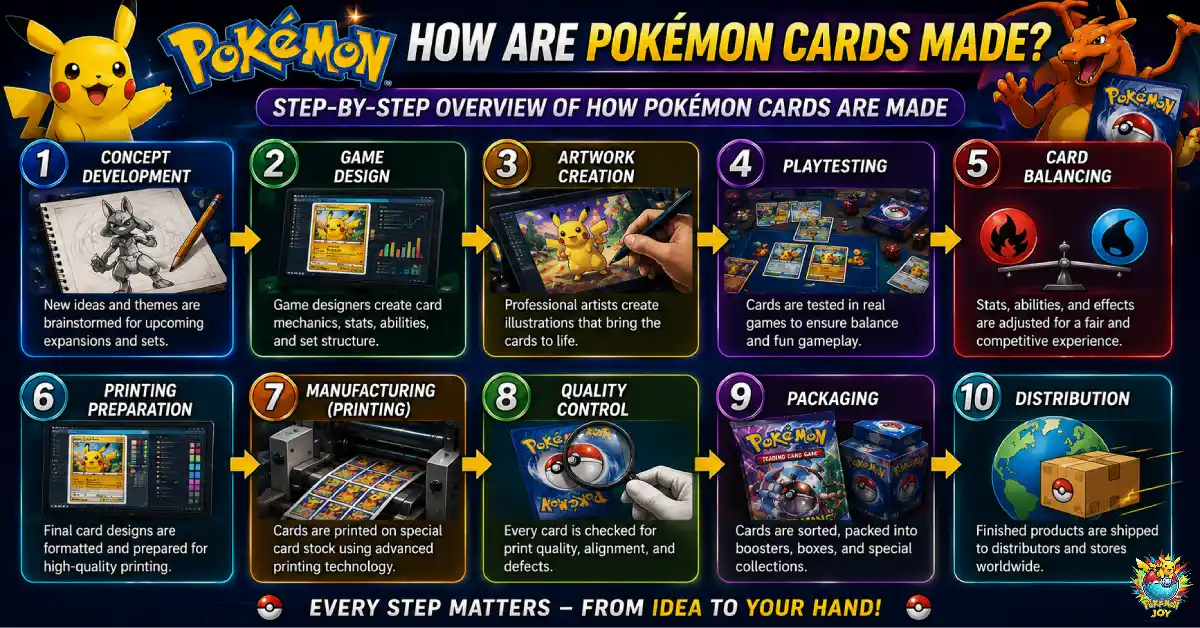
The Complete Process Behind Pokémon Card Production
Many people assume Pokémon cards are simply printed and packaged. In reality, many steps occur before cards are made available to the public.
The production process includes:
- Concept development
- Game design
- Artwork creation
- Playtesting
- Card balancing
- Printing preparation
- Manufacturing
- Quality control
- Packaging
- Distribution
Every stage must be completed successfully before a card reaches players.
How Many Steps Are Involved Before Cards Are Made
The process behind Pokémon card production can take months or even years.
A new expansion often begins long before players know it exists. Design teams work far in advance to prepare future releases.
This planning allows cards and expansion sets to launch on schedule throughout the year.
From Concept to Finished Booster Pack
Before a booster pack appears on store shelves, multiple departments contribute to its creation.
Artists create illustrations.
Designers build mechanics.
Game testers evaluate balance.
Production teams print the cards.
Packaging teams assemble products.
All these stages work together to produce the cards collectors eventually purchase.
Creating Pokémon Card Concepts and New Game Mechanics
The Work of the Game Design Team
The game design team begins every expansion by exploring new ideas.
They consider:
- Future Pokémon releases
- Competitive balance
- Theme concepts
- Gameplay innovation
The goal is to keep the Pokémon Trading Card Game fresh while maintaining familiar mechanics.
How Game Designers Create New Pokémon Card Ideas
Game designers study both existing cards and future game needs.
For example, if a new Pokémon appears in upcoming video games, designers may develop card concepts that reflect its abilities.
Creating Pokémon cards requires balancing creativity with gameplay requirements.
Game Data Designers and Card Balance
Game data designers analyze statistics and interactions.
They examine:
- Damage values
- Health points
- Abilities
- Energy requirements
These decisions influence how strong each card becomes during competitive play.
Creating Pokémon Abilities and Attacks
Each Pokémon card requires unique attacks and abilities.
Designers consider:
- Pokémon lore
- Battle themes
- Strategic value
The reason behind every ability must support both gameplay and Pokémon identity.
Testing New Game Mechanics Before Release
Before a card enters production, extensive playtest sessions occur.
Game testers evaluate the following:
- Balance
- Fairness
- Strategy
- Competitive impact
New game mechanics often undergo repeated revisions before approval.
A card that appears balanced on paper may become overpowered during actual gameplay.
That is why playtesting remains one of the most important stages in Pokémon card development.
Designing a New Pokémon Card
How Card Templates Are Created
Card templates establish the structure of every Pokémon card.
Templates determine:
- Card borders
- Text placement
- Energy symbols
- Attack sections
- Rarity indicators
Consistent card templates help players easily understand cards across different generations.
The Importance of Pokémon Card Layout and Readability
A Pokémon card must communicate information clearly.
Players need to quickly identify the following:
- HP values
- Attacks
- Weaknesses
- Resistance
- Retreat costs
Good design improves gameplay and reduces confusion.
How Illustrator Teams Bring Pokémon to Life
- Illustration is one of the most important aspects of Pokémon card production.
- Professional artists create images that capture each Pokémon’s personality and environment.
- The illustrator becomes responsible for transforming simple concepts into memorable artwork.
Ken Sugimori’s Influence on Pokémon Design
- Ken Sugimori helped establish the visual identity of Pokémon.
- His artwork influenced generations of Pokémon designs and card illustrations.
Mitsuhiro Arita and Iconic Cards
- Mitsuhiro Arita is one of the most respected Pokémon card artists.
- Many collectors consider his work among the most iconic cards ever created.
Satoru Inoue and Modern Pokémon Artwork
- Satoru Inoue contributed to numerous Pokémon card illustrations over the years.
- His artistic style helped shape modern Pokémon card aesthetics.
Atsushi Nagashima and Card Illustration Development
- Atsushi Nagashima has contributed to various Pokémon projects.
- Nagashima said that successful card illustrations must communicate both character and atmosphere.
- Artwork plays a major role in determining whether a card becomes memorable among collectors.
How Artwork Is Selected for Pokémon Cards
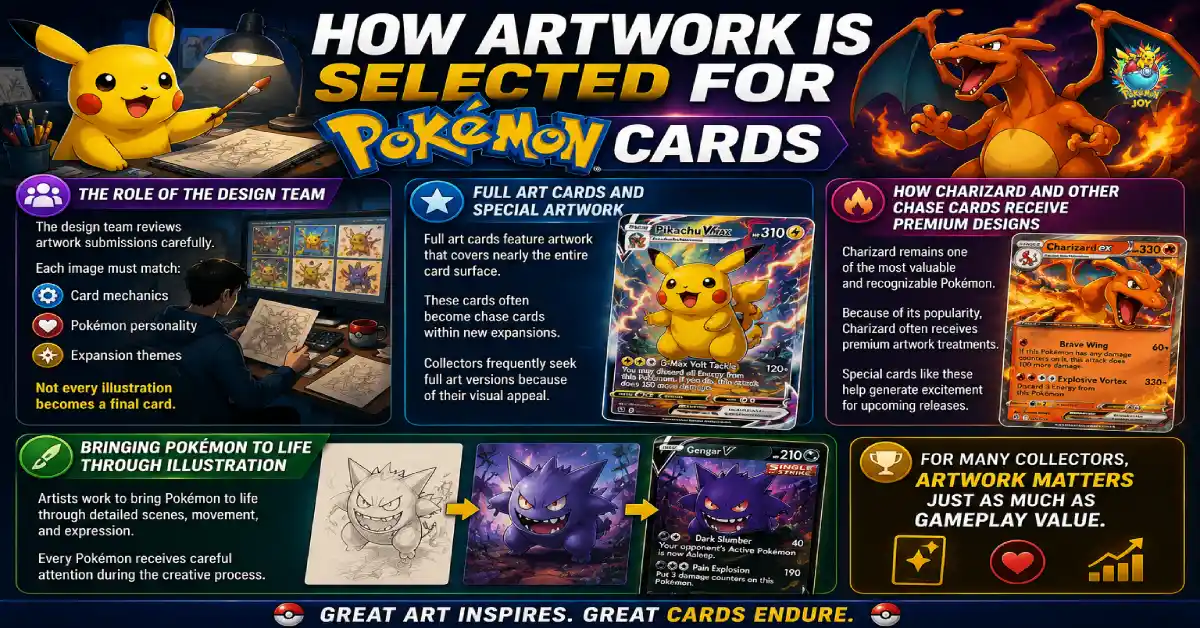
The Role of the Design Team
The design team reviews artwork submissions carefully.
Each image must match:
- Card mechanics
- Pokémon personality
- Expansion themes
Not every illustration becomes a final card.
Full Art Cards and Special Artwork
- Full art cards feature artwork that covers nearly the entire card surface.
- These cards often become chase cards within new expansions.
- Collectors frequently seek full art versions because of their visual appeal.
How Charizard and Other Chase Cards Receive Premium Designs
- Charizard remains one of the most valuable and recognizable Pokémon.
- Because of its popularity, Charizard often receives premium artwork treatments.
- Special cards like these help generate excitement for upcoming releases.
Bringing Pokémon to Life Through Illustration
- Artists work to bring Pokémon to life through detailed scenes, movement, and expression.
- Every Pokémon receives careful attention during the creative process.
- For many collectors, artwork matters just as much as gameplay value.
Pokémon Card Testing and Quality Control
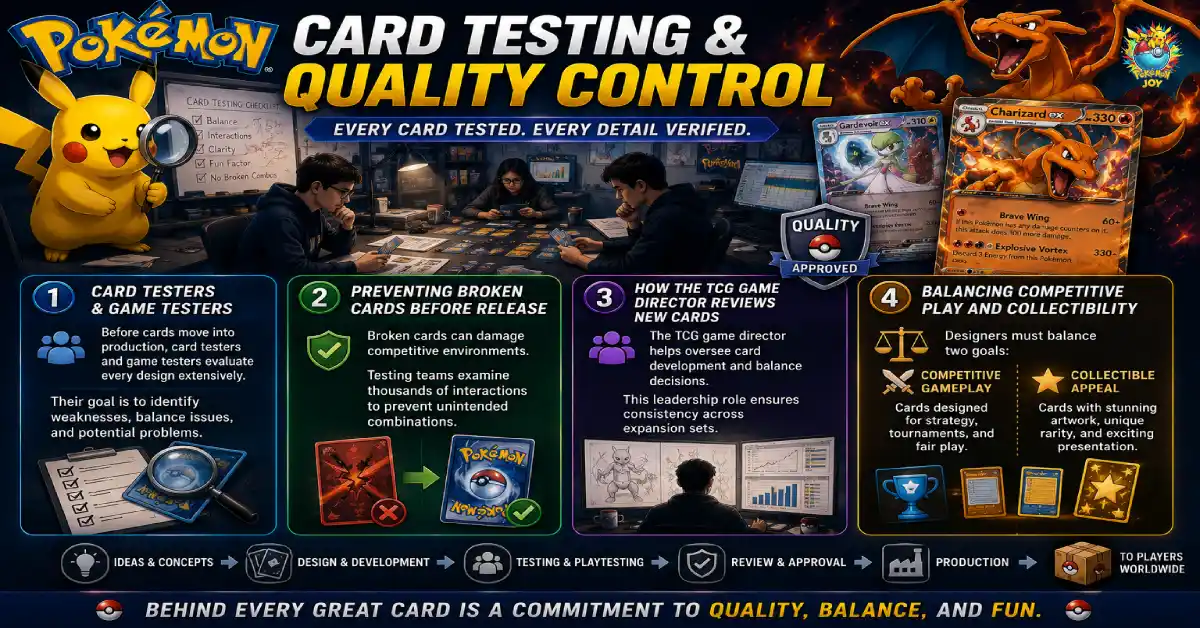
Card Testers and Game Testers
- Before cards move into production, card testers and game testers evaluate every design extensively.
- Their goal is to identify weaknesses, balance issues, and potential problems.
Preventing Broken Cards Before Release
- Broken cards can damage competitive environments.
- Testing teams examine thousands of interactions to prevent unintended combinations.
How the TCG Game Director Reviews New Cards
- The TCG game director helps oversee card development and balance decisions.
- This leadership role ensures consistency across expansion sets.
Balancing Competitive Play and Collectibility
Designers must balance two goals:
- Competitive gameplay
- Collectible appeal
Some cards focus on tournament play.
Others target collectors through artwork, rarity, and presentation.
The Pokémon Card Printing Process Explained
What Happens Before Cards Are Printed
Before cards are printed, every approved design moves into pre-production. At this stage, digital files are reviewed for accuracy, color consistency, card layout, and text placement.
The design team checks every element to ensure the final product matches Pokémon standards. Even a small error in attack text, rarity symbols, or artwork placement can delay production.
This stage also ensures that every card set follows the overall vision established during game design and testing.
Preparing Digital Files for Printing
Once designs are finalized, specialized printing files are prepared. These files contain:
- Artwork
- Card borders
- Text elements
- Symbols
- Security features
- Color specifications
The files are optimized for industrial printing systems capable of producing millions of cards.
A professional printer must maintain exact color accuracy because collectors can quickly notice differences between cards.
Printing Millions of Pokémon Cards
- Modern Pokémon card production operates at an enormous scale. Each year, millions of cards are produced and distributed worldwide.
- Large-scale facilities work continuously to produce the cards needed for global demand.
- The Pokémon Trading Card Game has become one of the world’s most successful collectible card games, requiring huge production capacity.
How Cards Are Printed on a Sheet
- Modern Pokémon card production operates at an enormous scale. Each year, millions of cards are produced and distributed worldwide.
- Large-scale facilities work continuously to produce the cards needed for global demand.
- The Pokémon Trading Card Game has become one of the world’s most successful collectible card games, requiring huge production capacity.
Millennium Print and Modern Printing Technology
Millennium Print has been publicly associated with Pokémon card manufacturing operations in recent years. Modern facilities use advanced equipment capable of producing precise colors, textures, and effects.
The printing process combines:
- High-resolution printing
- Color calibration
- Quality monitoring
- Surface treatments
These systems help maintain consistency across global releases.
The Role of Industrial Printers
Industrial printing equipment differs dramatically from ordinary commercial printing machines.
These systems can:
- Print the cards rapidly
- Apply specialized coatings
- Create holo effects
- Ensure alignment accuracy
Without this technology, large-scale Pokémon card production would be impossible.
How Holographic Cards and Rare Cards Are Made
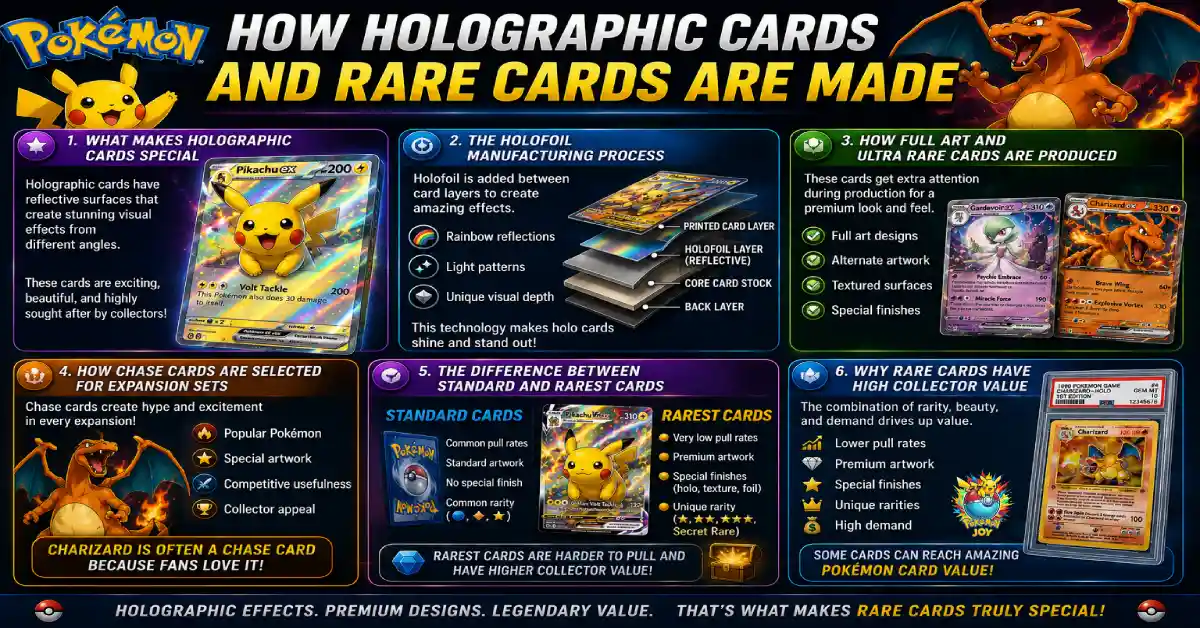
What Makes Holographic Cards Special
- Holographic cards are among the most exciting products in any expansion.
- Unlike standard cards, holographic cards contain reflective surfaces that create visual effects when viewed from different angles.
- Collectors often seek these cards because of their appearance and rarity.
The Holofoil Manufacturing Process
The holofoil process adds reflective material to specific card layers.
This effect creates:
- Rainbow reflections
- Light patterns
- Unique visual depth
Many collectors simply refer to these effects as holo cards.
The use of holofoil technology helps distinguish premium cards from standard releases.
How Full Art and Ultra Rare Cards Are Produced
Full art cards receive additional attention during manufacturing. The artwork extends across most or all of the card surface, creating a premium appearance.
Many of today’s rare cards feature
- Full art designs
- Alternate artwork
- Textured surfaces
- Special finishes
These cards often become highly desirable among collectors.
How Chase Cards Are Selected for Expansion Sets
Every major expansion includes chase cards designed to generate excitement.
These cards might feature:
- Popular Pokémon
- Special artwork
- Competitive usefulness
- Collector appeal
Charizard frequently appears as a chase card because of its popularity within the community.
The Difference Between Standard and Rarest Cards
The rarest cards typically receive the following:
- Lower pull rates
- Premium artwork
- Special finishes
- Unique rarity designations
Because of these features, certain cards can achieve remarkable Pokémon card value in the collector market.
How Pokémon Cards Are Cut, Sorted, and Inspected
How Cards Are Cut After Printing
- After printing, cards are cut from their large production sheets.
- Specialized equipment ensures cards are cut accurately and consistently.
- This stage is critical because poor cutting can affect card appearance and grading results.
- The point where cards are cut transforms large sheets into individual cards ready for inspection.
Quality Inspection Procedures
Quality control teams examine:
- Color accuracy
- Surface quality
- Alignment
- Corners
- Centering
These inspections help ensure that official Pokémon products meet expected standards.
Detecting Printing Errors
Errors occasionally occur despite strict controls.
Examples include:
- Misprints
- Alignment issues
- Ink problems
- Missing layers
Some errors become highly collectible among enthusiasts.
Preparing Individual Cards for Packaging
- Once inspection is complete, individual cards move toward packaging systems.
- Cards are organized according to rarity, distribution requirements, and booster pack configurations.
How Booster Packs and Booster Boxes Are Assembled
How Individual Cards Go Into Booster Packs
- A booster pack contains a randomized selection of cards.
- Automated systems place cards into packs while maintaining predetermined rarity ratios.
- This randomization creates excitement for collectors opening new products.
Randomization Systems in the Pokémon Trading Card Game
- Randomization helps ensure fairness and variety.
- The Pokémon Trading Card Game relies on carefully designed distribution systems so players can discover different cards through pack openings.
Packaging Cards and Expansion Sets
After randomization, cards move into sealed packaging.
The packaging stage includes:
- Wrappers
- Security sealing
- Product labeling
At this point, cards and expansion products become retail-ready.
Booster Box Manufacturing and Distribution
Multiple booster packs are combined to create a booster box.
These boxes become important products for:
- Collectors
- Competitive players
- Retail stores
Many players purchase booster boxes when new expansions launch.
How Pokémon Cards Reach Stores Worldwide
Distribution Centers and Global Shipping
- Once manufacturing is complete, products enter international distribution networks.
- Large warehouses coordinate shipments to retailers around the world.
- Products may travel thousands of miles before reaching consumers.
How Cards Are Sold Through Retailers
Cards are sold through:
- Hobby stores
- Online retailers
- Department stores
- Official Pokémon channels
This distribution network allows fans worldwide to access new releases.
Pokémon Center and Official Pokémon TCG Product Distribution
The Pokémon Center serves as an official retail destination for many collectors.
Popular products include:
- Pokémon Center ETB
- Pokémon Center booster box
- Pokémon Center trading cards
- Pokémon Center TCG products
- Pokémon Center Celebrations ETB
- Pokémon Center Chilling Reign ETB
- pokemon card maker
- Pokémon Center Celebrations Elite Trainer Box
- Pokémon Center Charizard UPC
- Pokémon TCG, Pokémon Go, Pokémon Center Elite Trainer Box Plus
Collectors often purchase exclusive releases through official channels.
From Factory to Collector
- The journey from Pokémon card factory to collector involves logistics, quality control, retail distribution, and inventory management.
- Only after all these stages are complete do cards reach consumers.
Pokémon Card Rarity and Pokémon Card Value
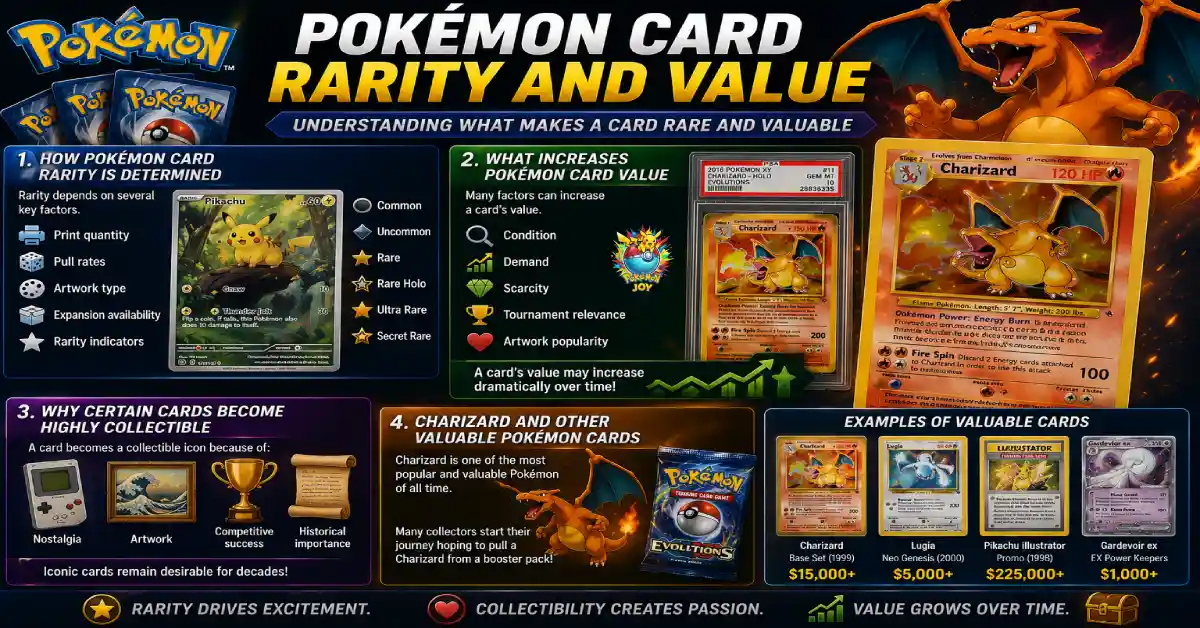
How Pokémon Card Rarity Is Determined
Pokemon card rarity depends on several factors:
- Print quantity
- Pull rates
- Artwork type
- Expansion availability
Rarity indicators help players identify valuable cards.
What Increases Pokémon Card Value
Several factors influence Pokémon card value:
- Condition
- Demand
- Scarcity
- Tournament relevance
- Artwork popularity
A card’s value may increase dramatically over time.
Why Certain Cards Become Highly Collectible
A collectible card often gains popularity because of
- Nostalgia
- Artwork
- Competitive success
- Historical importance
Iconic cards frequently remain desirable for decades.
Charizard and Other Valuable Pokémon Cards
Few Pokémon match the popularity of Charizard.
Charizard has appeared on some of the most valuable and recognizable Pokémon cards ever released.
Many collectors begin their hobby hoping to pull a Charizard from a booster pack.
Pokémon Card Factory Myths and Common Misconceptions
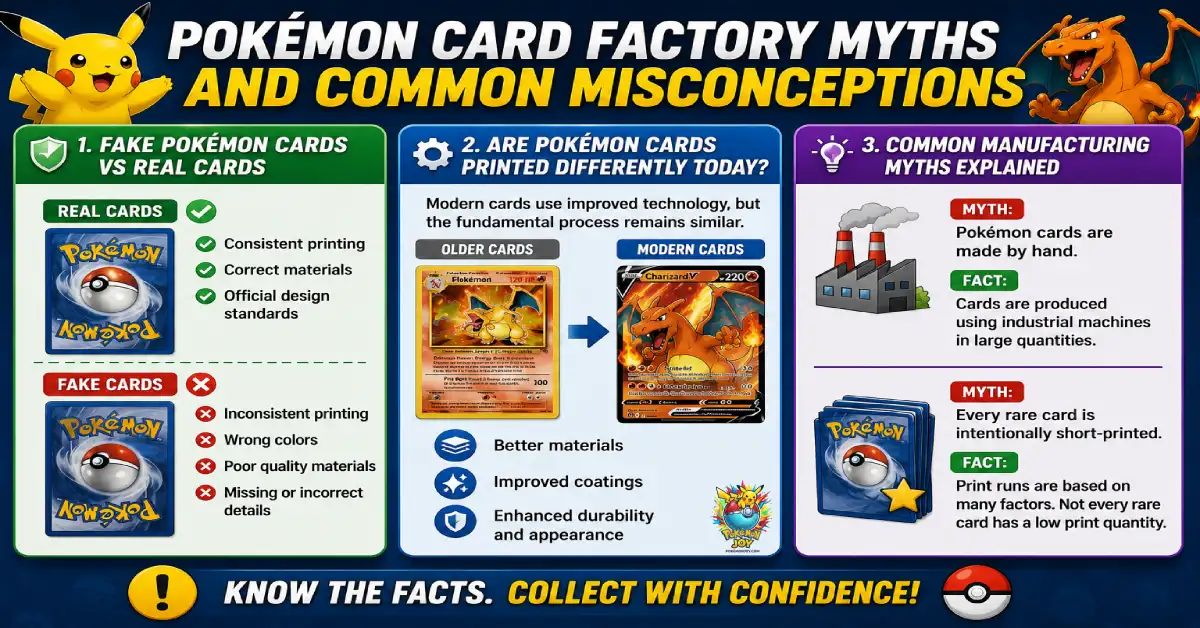
Fake Pokémon Cards vs Real Cards
One of the most common collector concerns involves fake Pokémon cards vs. real products.
Authentic cards feature:
- Consistent printing
- Correct materials
- Official design standards
Counterfeit products often display noticeable flaws.
Are Pokémon Cards Printed Differently Today?
Modern cards use improved technology, but the fundamental process remains similar.
Advances in materials, coatings, and manufacturing have improved durability and appearance.
Common Manufacturing Myths Explained
Many professional workers have the separate regarding production.
Some people believe cards like Pokémon cards are handmade individually. In reality, industrial processes handle large-scale production.
Others assume every rare card is intentionally short-printed, which is not always true.
Modern Pokémon Card Production and Future Technology
Advances in Pokémon TCG Printing Technology
Modern Pokémon TCG manufacturing continues evolving.
New technologies improve:
- Print quality
- Security
- Durability
- Visual effects
New Security Features
- Manufacturers constantly introduce features that help combat counterfeiting.
- These improvements protect collectors and maintain trust in the hobby.
Future Card Manufacturing Innovations
Future innovations may include:
- Enhanced holographic effects
- New materials
- Improved sustainability
- Advanced security measures
How Pokémon Cards Continue to Evolve
- As the franchise grows, so does Pokémon card production.
- Future expansions will likely introduce new printing techniques and design possibilities.
Pokémon Card Creation Tools and Fan-Made Projects
Outside official production, many fans enjoy designing custom cards.
Popular tools include:
- Pokémon card maker
- Pokémon card creator
- custom Pokémon card maker
- Pokémon trainer card maker
- Pokémon card maker online
- Pokémon card creator pack
- Pokémon card maker gx
- Pokémon card maker vmax
- pokecardmaker
- pokecharms trainer card maker
These tools allow hobbyists to create personal projects, but they are separate from official Pokémon card manufacturing.
Communities such as Pokémon Trading Center, Pokémon Trading Card Center, Pokémon TCG Center, and Pokémon Go Trade Center help fans share collections and discuss card designs.
Collectors may also search for products and references such as:
- kanazawa pikachu box
- ex-legend maker card list
These items demonstrate the depth and variety of the Pokémon collecting hobby.
Conclusion
Understanding how Pokémon cards are made reveals just how much work goes into every release. From the earliest concept and illustration to playtesting, manufacturing, printing, cutting, packaging, and distribution, the process involves many steps and hundreds of skilled professionals.
Companies such as Creatures Inc., The Pokémon Company, artists, game designers, game data designers, card testers, and production teams all contribute to bringing Pokémon to life.
Whether you collect old cards, chase modern full art cards, enjoy competitive play, or simply appreciate the artwork, every Pokémon card represents an enormous creative and manufacturing effort.
The next time you open a booster pack, remember that the card in your hands traveled through one of the most fascinating production systems in the collectibles industry. That journey is the true process behind how Pokémon cards are made.
Frequently Asked Questions ?
How are Pokémon cards made?
Pokémon cards are made through a multi-step printing process. The artwork is printed on high-quality cardstock, followed by protective coatings, cutting, and quality checks. Special cards may receive holographic or foil finishes before being packaged for sale.
What materials are used to make Pokémon cards?
Pokémon cards are made from durable layered cardstock with a printed paper surface. They also include a protective coating that helps improve durability and color quality. Some rare cards use additional foil or holographic materials for special effects.
Where are Pokémon cards manufactured?
Pokémon cards are produced in specialized printing facilities licensed by The Pokémon Company. Different regions, including Japan and the United States, use approved manufacturers to produce cards that meet official Pokémon TCG quality standards.
How are holographic Pokémon cards made?
Holographic Pokémon cards are created by adding a reflective foil layer during the printing process. This foil is combined with the printed design to produce the shiny effect seen on rare and special Pokémon cards.
Are Pokémon cards printed on regular paper?
No, Pokémon cards are not printed on regular paper. They use thick, high-quality layered cardstock designed for durability and consistent gameplay. The protective finish also helps prevent everyday wear and fading.
How long does it take to make Pokémon cards?
The complete production process depends on the size of the print run and quality testing. Printing, coating, cutting, inspection, and packaging all take time to ensure every Pokémon card meets official standards before distribution.